
Color Machine Vision System

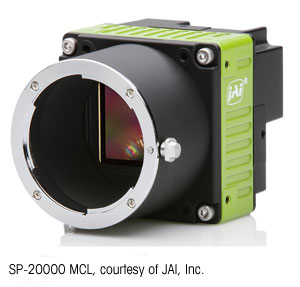
Today, printed circuit boards require more color vision solutions because the color of a component helps to identify each part. Plugs and connectors are color coded, and at the same time, the board is tracked using a black-and-white barcode. “These applications used to be done with a high-resolution monochrome camera, but now, you need to be able to sense color to make sure the right component and connector are in the right place,” Kinney explains. “The barcode will usually be located at the edge of the frame. If you use a single-chip color camera, you have to be concerned about color shading and halos at the edge of the image, and it’s made worse if you use cheap optics.”

White LEDs are made one of two ways: by applying a phosphor coating over a blue LED light that produces a broadband light closer to white light, or by mixing different-colored LEDs to make a broadband light source. Both methods result in a spectral continuum that is higher in some narrow wavelength bands within the white light spectrum compared to others. For the most challenging color vision applications, designers need to carefully match these “spikes” to the specific wavelengths. This is where choosing a lighting supplier with in-house engineers can really help, adds Metaphase’s Technical Sales Manager, Mark Kolvites. A quality supplier will make sure that the actual red, green, and blue (or more) LEDs mix to create a white light, or the blue LEDs with phosphor coating provide uniform illumination without hotspots that can cause trouble for automated inspection systems.
As the information above shows, color machine vision solutions can require in-depth knowledge of the physics behind machine vision. The good news is that by choosing the right supplier and partner, designers can solve applications where success isn’t just black and white.

refer to:http://www.visiononline.org/vision-resources-details.cfm/vision-resources/Is-Your-Machine-Vision-System-Color-Blind/content_id/4333

Business Transformation Through Remote Collaboration, Optimization And Operations

The ability to operate and manage operations in a location-agnostic manner opens the door to a wealth of opportunities. For instance, experts and operations staff can be relocated to population centers, and out of harms’ way. They can then be leveraged over multiple assets in real-time to ensure maximum utilization. Networking collaboration also allows for much faster creation and utilization of best practices across a network of operating assets, thereby contributing to better knowledge retention and management as well as greater efficiency, and establishing a true, shared corporate culture throughout the enterprise.
Real-World Stories

Offshore operations

The Situation: A leading global producer of crude oil and natural gaslooked for a way to stay ahead of dynamic market demands and overcome challenges associated with offshore oil and gas Automation. As part of an innovative technology project and with the help of Honeywell, this company built a Solutions to help coordinate control of multiple offshore platforms in the North Sea, and improve operations and efficiency.

With the new CCR, this company has centralized operations at 18 of its 26 offshore platforms. All operating and production procedures are fully automated and synchronized, creating increased flexibility and competitive advantage. At the heart of CCR is Honeywell’s Experion Process Knowledge Management System (PKS), which enables operators to monitor and control production at various platforms.

In this particular case, the bigger-picture business goal was time to first oil enabled by an out-of-the-box, customized solution. Even bigger than that, though, is that the refiner estimates a 4-to-6 percent production increase with real-time data networking and analysis.

refer to:

http://www.automation.com/business-transformation-through-remote-collaboration-optimization-and-operations

From kindergarten to Kickstarter

Now, Kickstarter projects like Ninja Blocks are shipping Internet of Things (IoT) devices based on the BeagleBone (see this article’s lead-in photo), and startup GEEKROO is developing a Mini-ITX carrier board that will turn the Raspberry Pi into the equivalent of a PC. Outside of the low barrier to market entry presented by these low-cost development platforms, maker boards are being implemented in commercial products because their wide I/O expansion capabilities make them applicable for virtually any application, from robotics and industrial control to automotive and home automationsystems. As organizations keep enhancing these board architectures, and more hardware vendors enter the DIY market, the viability of maker platforms for professional product development will continue to increase.

refer to:

http://embedded-computing.com/articles/diy-pushes-open-hardware-kindergarten-kickstarter/

Leveraging IT Technology for industrial controls applications

It is the author’s opinion that integration of the controls networking  and the IT network is inevitable. It became inevitable the moment the controls industry chose to use Ethernet as the medium with which to communicate data. The controls industry may choose to be dragged kicking and screaming into the modern automation era, or it can gracefully embrace the change. Embracing means the controls industry would be able to leverage the myriad rich, existing technologies that have been proven foolproof in the IT world. To be dragged kicking and screaming into the modern communications era would do a terrible injustice to those who have worked diligently to bring it about. This could quite possibly add an entirely new facet to the fieldbus wars, which I hope have not been forgotten.

With that said, the controls world is going to be moving with an industry that has a definite consumer bias, with product development and release cycles of six months or less. In an industry where the average life expectancy of an automotive production line is eight years, it is impossible to expect the networking  in an industrial setting to keep up with modern IT standards. Therefore, we turn our attention to the technologies that have existed the longest, with the most open standards and the very best support. These are the protocols we wish to use and keep, and this article highlights and explains some of these technologies.

This article does not focus on the technical implementations of each piece of technology. Rather, it is assumed the reader will be using packaged solutions such as a function block for a PLC. These packages typically require only that the user specifies the relevant server to connect to, the data to be gathered and an activation bit. The particulars of each protocol and concept are, ideally, transparent to the user, and therefore it is not pressing that the user understands what is contained in each packet passed between the server and the client. As each protocol described in this article is openly documented and supported, a simple search on the Internet for the technical details will likely yield the relevant automation details.

refer to:
http://www.automation.com/leveraging-it-technology-for-industrial-controls-applications

Rufus in the embedded product designs

The possibilities for embedded product designs are exploding. Leveraging a myriad of connectivity interfaces and integrating advanced graphical user interfaces and multimedia formats requires the availability of supporting software stacks from the underlying operating system. And, more than ever before, embedded software teams are turning to open source software and embedded Linux as the platform on which to base these systems in the “Internet of Things.” But while open source has proved itself incredibly technology enabling, it can also make the workflow excessively unwieldy. The good news is that solutions and best practices exist to help development teams improve their embedded product workflow when open source is an increasingly large part of the mix.

Ensuring that the development team is aware of embedded computer – and in compliance with – the obligations associated with each of these open source licenses takes time and effort. Tools that can help to identify and track the underlying licenses that apply and enable license obligations to be met can prove quite valuable when trying to hit aggressive solutions  from product development milestones.

refer to: http://embedded-computing.com/articles/the-not-code-quality/

To a better innovative future

It succeeds in providing significant speed enhancements and breakthroughs while keeping  In-Vehicle computers to costs down. MOST150 enables the use of a higher bandwidth of 150 Mbps, an isochronous transport mechanism to support extensive video applications, and an embedded Ethernet channel for efficient transport of IP-based packet data.

To clear things up, it succeeds in providing significant speed enhancements and breakthroughs while keeping costs down. The new Intelligent Network Interface Controller (INIC) architecture complies with Specification Rev. 3.0 and expands the audio/video capability for next generation automotive infotainment devices such as Head Units, Rear Seat Entertainment, Amplifiers, TV-Tuners and Video Displays.

refer to: http://embedded-computing.com/news/most150-series-adoption/

Scalable challenges for embedded pc manufacturers


However, inevitably, the types of processors that will succeed in the future will be the SoCs that provide hardware-accelerated functions. It’s the only way that applications will be able to meet their performance-power budgets. In other words, embedded computer with homogeneous SMP devices, the performance gained by increased core count is not scalable. For example, the more embedded computer cores that share a common bus structure, the more that each core must compete for memory bandwidth. This problem can be alleviated by designing chips that divide cores into clusters, where each cluster can operate autonomously if necessary.

What plans does the EEMBC have to expand its offerings in the future, and how can the industry get involved?

refer to: http://embedded-computing.com/articles/moving-qa-markus-levy-founder-president-eembc/


Broad scalability for Intel® Core™ processors

With improved processing and graphics performance as well as energy efficiency and broad scalability. The 4th generation Intel® Core™ processors serve the embedded computing space with a new microarchitecture which Kontron will implement on a broad range of embedded computing platforms.  Beside a 15% increased CPU performance especially the graphics has improved by its doubled performance in comparison to solutions based on the previous generation processors. At the same  embedded computing , the thermal footprint has remained practically the same or has even shrunk.

refer to: http://embedded-computing.com/white-papers/white-intelr-coretm-processors/

Combination for in-vehicle drive and medical use

The Qseven specification supports Windows Embedded, Linux, and other Real-Time Operating Systems (RTOSs) on in-vehicle computers, and Windows Embedded and Linux for ARM. Although Windows initially drove medical segment, some users now prefer Android OSs because they can create custom apps, it is easy to find Android developers, there are no licensing fees, Kodavarti adds. Go to doctor’s office. Wait. See Primary Care Physician. Get tested. Wait. Get referred to specialist. Get retested. Wait. Get referred to another specialist. Wait. See how much in-vehicle computers that pay accordingly.

The Qseven specification supports Windows Embedded, Linux, and other Real-Time Operating Systems (RTOSs) on x-86 modules, and Windows Embedded and Linux for ARM. Although Windows initiallyThis is just one example of why telehealth strategies are poised to revolutionize medicine. Telehealth not only provides quick access to specialists, but can also remotely monitor patients and reduce clinical expenses. Many of the systems needed to realize these benefits will operate on the edge, and require technology with the portability and price point of commercial mobile platforms, as well as the flexibility to perform multiple functions securely and in real time. All of this must be provided in a package that can meet the rigors of certification and scale over long lifecycle deployments.ee how much insurance covers. Pay accordingly.

refer to: http://smallformfactors.com/articles/qseven-coms-healthcare-mobile/

Lower-profile solutions for alternative embedded power control

Blade VLP is a lower-profile (17.78 mm) alternative to the JEDEC standard VLP with a height of 18.75 mm (see Figure 1). Reducing the height of a DDR3 VLP memory module to a lower-profile 17.78 mm solves the space-constrained limitations found in many telecom and networking applications, where it is difficult to accommodate the memory required for both an industry-standard DIMM or Mini DIMM socket plus a standard VLP. This approach allows designers to reduce the total power in embedded systems that use multiple memory modules and those that must run above +85 °C, which is a typical design challenge in a wide range of AdvancedTCA-based telecom and Ethernet blade switch networking applications.

refer to: http://embedded-computing.com/articles/ruggedization-memory-module-design/